Our Tree-mendous Glossary
Trees are our bread and butter, and we do tend to throw some leafy lingo around. We always want to be as clear as possible, so we’ve whipped up a handy A to Z glossary to help you navigate our tree services with ease.
So, whether you’re stumped by stump grinding or wondering what windthrow really means, get ready to grow your knowledge and read on for all you need to know.
A
- Adaptive Growth
- When a tree gets stressed or damaged, it may undergo adaptive growth — this is where it grows new wood or branches to keep itself standing tall.
- Adventitious / Epicormic Growth
- This refers to the buds that appear on a tree’s trunk or main branches, usually after pruning or during times of stress.
- Ancient Trees
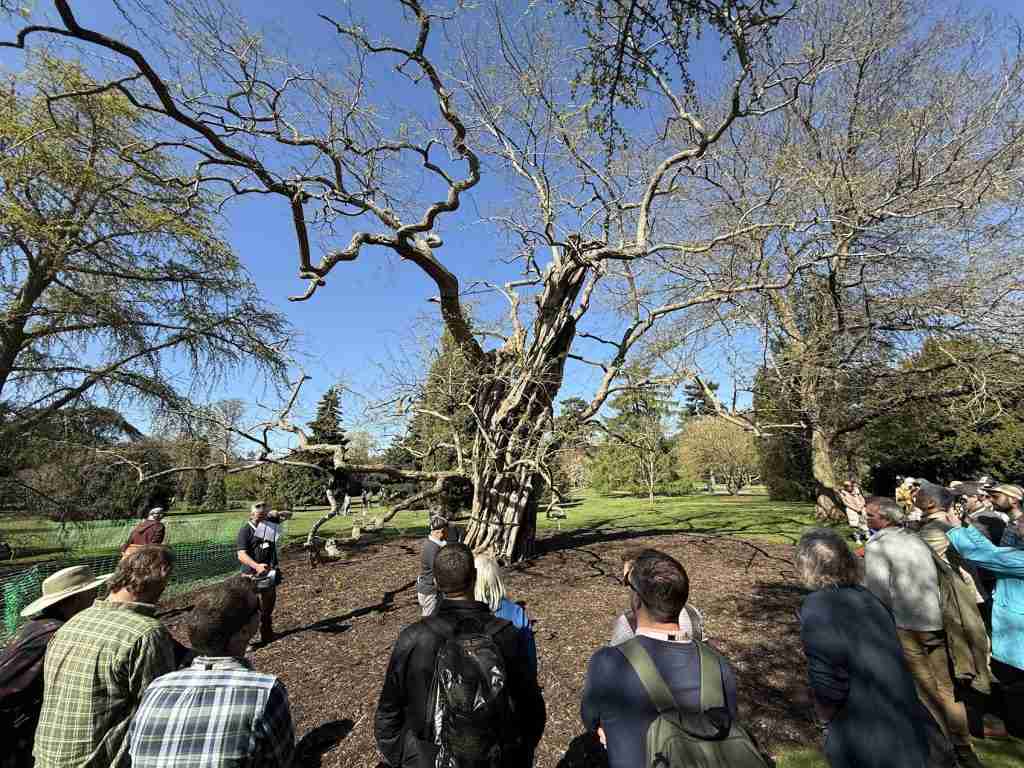
- Protected trees due to their old age and large size. They usually hold cultural significance or are part of a nature conservation area.
- Arboriculture
- This is the fancy name for the care and management of trees – especially in places where people live, like streets, parks, gardens, and school grounds.
- Arborist
- An arborist practises arboriculture. They have the knowledge and training to identify tree diseases, recommend the best course of action, and put tree management plans in place. Not to be confused with tree surgeons (see below).
- Arisings
- These are any bits and pieces of debris, including leaves, twigs, and logs, left after a tree surgery job. We always tidy them up, and take them away, unless you’d like to keep them for mulch or firewood.
B
- Bracing
- Sometimes, we need to use ropes and rods to support weak branches while carrying out a job.
- Branch Collar
- The collar is the junction where a branch attaches to the tree trunk (or a larger branch). It usually has a bit of a bulbous appearance.
- Branchwood
- Put simply, this is the name for branches — the woody protrusions from a tree trunk. We’ll normally use this term when we’re talking about branches that have been removed from a tree.
- Brash
- After pruning a tree, there will be foliage, twigs, and very small branches — this is known as brash.
- Brushwood
- In tree surgery, this usually means a mixture of brash and smaller branches removed from a tree. Elsewhere, you may also hear it when talking about low undergrowth.
- Buttress Roots
- These are the roots at the base of a tree trunk.
C
- Cable Brace
- A strong, semi-flexible cable to help with bracing by supporting heavier loads.
- Canopy
- The beautiful, leafy part of a tree — all its upper branches — creates the ‘canopy’. (Birds and squirrels love to hang out here.)
- Cavity
- Ever seen a cartoon tree with a hole in the trunk? That’s a cavity. Although it’s usually due to decay or damage and can be a weak point, it also creates a habitat for wildlife.
- Conservation Area (CA)
- A Conservation Area is a designated zone where the character and appearance of the environment, including trees and buildings, are protected by the local council. If you live in a Conservation Area, you must apply for permission before carrying out any work that may affect trees or alter the area’s appearance. Approval typically takes up to six weeks.
- Co-dominant Stems
- Co-dominant stems branch from the same point on a tree, creating a ‘v’ shape. They are the same general diameter.
- Crown
- Similar to a tree’s canopy, its crown is the leafy top of the tree, referring to its branches, leaves, and shoots.
- Crown Cleaning
- Also known as ‘dead wooding’, this is where we remove any dead, dying, or damaged branches and leaves from the tree crown to give it a good tidy.
- Crown Lift
- Sometimes, we remove some of the tree’s lower branches to lift the crown and let more light in and create space in your garden.
- Crown Reduction
- This is where we trim the canopy to reduce its overall size and try to retain the tree’s natural shape.
- Crown Thinning
- Here, we prune the crown by removing inner branches. This helps more light reach the tree without reducing its overall canopy size. Crown thinning also allows light through the tree and into your garden for a more dappled shade.
D
- Deadwood
- Any dead branches or stems. They may have simply aged or could be affected by disease.
- Decline
- If a tree is in decline, it’s looking worse for wear. It’s not dead — and it can likely be rescued — but it may be losing leaves, thinning, or showing signs of stress.
- Dieback
- This is where a tree starts dying at the tips (branches or roots).
- Disease
- Just like any other being, trees can get sick! There are many tree diseases that can affect different species — don’t worry, tree surgeons and arborists can work on a treatment plan.
- Dormant
- During the colder months, many trees (aside from evergreens) essentially hibernate. When they are dormant, trees shed their leaves and pause growth as they recharge, ready to flourish in spring.
- Drip Line
- If you look at a tree from a bird’s eye view, the drip line would be a circle around the crown edge, showing where rain drips from the leaves to the ground.
- Drop Crotching
- This crown thinning technique involves trimming a tree’s size while retaining its natural shape.
F
- Felling
- As you might expect from our name, The Tree Fella likes a good tree fell(er). Felling essentially means carefully cutting a tree down completely.
- Formative Pruning
- By pruning young trees, we can guide them into a desired shape and prevent some physical weaknesses — this is formative pruning.
- Fungal Fruiting Bodies
- Fungi are fascinating, but much of their structure is tucked away underground. The mushrooms and other fungal structures we see above ground are the ‘fruiting bodies’.
H
- Hazard Beam
- Any branch that might pose a safety risk.
- Height Reduction
- This involves trimming a tree’s size from the top to reduce its height.
I
- Included Bark
- When branch stems grow very closely together, they can lead to bark developing between them, creating a weak spot.
L
- Leader
- This is the main stem that grows from a tree and wants to be the leader of the pack!
- Lion Tailing
- Pruning willy-nilly and taking away too many inner branches can result in lion tailing — you’ll see leaves at the ends of the branches only, looking like the tufts of a lion’s tail. It’s a big no-no — leave it to the tree pruning experts.
- Lopping
- This is where large branches are removed from the side of the tree using vertical cuts. Lopping is generally considered poor practice.
M
- Monolith
- A monolith is a standing dead or dying tree that has been deliberately retained or modified for conservation purposes. By keeping the trunk or main structure of the tree in place, monoliths provide vital habitats – such as cavities, cracks, and decaying wood – for birds, insects, fungi, and other wildlife. This practice supports biodiversity, even after the tree’s life has ended.
P
- Pollarding
- This technique involves trimming back branches to the same point every few years to retain a tree’s size and shape. Pollarding is only suitable for certain tree types, so always check with a professional.
- Pruning
- You’ll hear us talk about this a lot — the careful cutting of branches to keep a tree healthy and safe.
R
- Retrenchment Pruning
- There are various pruning techniques, and this one focuses on helping a tree’s lower branches grow. It’s a gentle method that reflects how trees naturally shrink back as they age.
- Rigging
- When working at height, we sometimes need an array of ropes, pulleys, and nifty equipment to keep us safe.
- Root Flare
- Take a look at the base of a trunk where it meets the roots — this is the root flare!
- Root Pruning
- As you might imagine, this is a form of pruning that trims a tree’s roots.
S
- Section Felling
- Ideal for trees in snug places, section felling involves dismantling a tree in sections.
- Selective Reduction
- If there are branches outside of a tree crown’s uniform shape, selective reduction removes them.
- Stump Grinding
- If you want to feel cool when removing a tree stump, grinding is the way to go. We use a power tool to grind away at the wood until it’s gone. This is the best way for removal if you want to replant.
- Stump Removal
- Does what it says on the tin — this is where we remove a tree stump. Learn more about our tree stump removal services.
- Subsidence
- This can affect branches or the ground. Branch subsidence is when a branch droops or lowers because it is too heavy or overgrown. Tree roots can also lead to building subsidence by soaking up too much moisture and creating cracks in structures.
T
- Taper
- A tree’s main stem may taper, getting smaller in diameter towards the top.
- Thinning
- See Crown Thinning.
- Topping
- Like lopping, we don’t recommend topping — this is where you chop off a big chunk of the top of a tree’s crown. Problems associated with topping include weakly attached new growth and stem decay.
- Transplant Shock
- If a tree needs to be moved (transplanted), it’s important to do so very carefully to avoid root damage and stress, which can leave it in a state of ‘shock’.
- Tree Crown
- See Crown and Canopy.
- Tree Constraints Plan
- This map shows the location of trees and their potential impact on future building or landscaping plans. It protects trees by essentially showing developers where they aren’t allowed to dig.
- Tree Risk Assessment (TRA)
- We can carry out a TRA to see if a tree might pose a risk to people or property.
- Tree Line
- The visible edge where a group of trees ends.
- Tree Protection Plan (TTP)
- Trees have been around for a long old while, so developers shouldn’t just bulldoze their way through. A TTP keeps existing trees safe from disruption by setting out measures like fencing, no-dig zones, and rules for machinery.
- Tree Protection Order (TPO)
- Some trees are deemed by the Local Council to be important to the look and feel of an area. In this case, the Local Council places a TPO on the tree to protect them. If you have a TPO tree in your garden you need to apply to your local council for any works that you’d like to do. We can do this for you as part of the works that are applied for or you can do it yourself.
- Tree Surgeon
- Is there a doctor in the house? No, but there is a surgeon in the woodland. Tree surgeons work alongside arborists to keep trees safe and healthy — they carry out the physical treatment side of things, like pruning, pollarding, and felling.
- Tree Survey
- This is an account of any trees on a certain site (usually before construction or development). Along with other details, it’ll factor in species, size, health, and location info.
- Trunk
- The main stem of a tree (perfect for hugging if you’re so inclined).
U
- Uprooting
- Where an uprooted tree is torn from the ground so that its roots come up. Common culprits include storms, overly soggy soil, and shallow rooting.
V
- Veteran Tree
- Respect your elders – and survivors! Veteran trees may not always be ancient, but they’ve developed key features such as cavities, crevices, and deadwood that are valuable for wildlife. These trees are often in their mature stage of life and may show signs of age, damage, or environmental stress that contribute to their ecological importance. While they may not be as old as ancient trees, veteran trees are still protected for their biological, cultural, or historical value.
- Visual Tree Assessment
- A Visual Tree Assessment (VTA), according to David Lonsdale, is a structured method of tree inspection that focuses on the observation of external symptoms to infer internal mechanical condition and structural integrity. In his pioneering book “Principles of Tree Hazard Assessment and Management” (1999), Lonsdale describes VTA as: “A method of assessing the mechanical integrity of trees based on the external appearance of their parts and growth responses, supported by biomechanical principles and an understanding of tree biology.”
W
- Wilting
- Leaves that look droopy, limp, and a bit sorry for themselves are wilting. Sometimes, a good drink of water will perk them up.
- Windthrown
- Also known as ‘windblown’, this is a tree that has toppled over because of strong winds.
- Wood Decay
- Fungi can cause the wood inside a tree to become soft, spongy, and eventually break down. Wood decay can naturally happen in older trees, but when too much occurs, the structure can weaken.
Y
- Yellowing
- For the most part, healthy leaves are green. If they start turning yellow, it’s a sign they may need a little TLC. In the autumn, however, some trees may naturally let their leaves go yellow before dropping them.
Your North East tree experts
Our residential and commercial tree surgeons are rather well-versed in the language of trees. If you have any questions or want to book any of our tree services, don’t hesitate to get in touch with The Tree Fella team.