Tree Safety Surveys, Inspections, and Assessments
At The Tree Fella, we treat every tree as if it were our own, delivering expert care and attention from root to crown.
From detailed tree safety inspections to comprehensive tree surveys, we deliver expert tree safety services you can rely on.
- Informal Checks
- Walk-over Assessment
- Detailed Inspection
- Full Inventory Tree Survey
“While trees are generally very low risk, responsible management is essential. At The Tree Fella, we combine trusted expertise with Arb Approved standards to keep people and property safe while helping trees thrive.”
Simon Forster – Principal Arborist at The Tree Fella
Our tree safety management checks are available for both commercial and residential tree owners across South Tyneside, Sunderland, Gateshead, Newcastle, and across the wider North East region.
We aim to educate our clients on a common sense approach to tree risk management, and always encourage tree owners to follow the guidance of the National Tree Safety Group (NTSG) and the document ‘Common Sense Risk Management of Trees’, Second Edition, 2024.
Keep your trees safe, healthy, and stay compliant with our individual tree safety inspections, tree condition surveys and tree assessments. Feel free to fill in our service request form today.
Informal Checks
Every tree owner has an ongoing responsibility to keep an eye on their own trees. Informal checks, a quick, common sense look for obvious problems like storm damage, hanging branches, or dead wood, are something you’re expected to carry out yourself between formal inspections. We don’t charge for this, it’s part of being a responsible tree owner.
As a tree owner, the law expects you to act as a “reasonable and prudent landowner” (NTSG 5.4.3). That doesn’t mean guaranteeing a tree is completely safe, no tree owner can promise that, but it does mean taking sensible, proportionate steps to manage the risk.
In practice, that means keeping up your own informal checks between formal inspections, and following the guidance of the National Tree Safety Group (NTSG), the Forestry Commission, and the Arboricultural Association.
This is where your day-to-day responsibility ends and ours begins. Our Walk-over Assessment, below, is the next step.

Walk Over Assessment
A Walk-over Assessment is the simplest formal check we offer, but it’s also extremely insightful. This type of survey is carried out by a qualified Professional Tree Inspector and identifies trees that warrant closer attention.
This is a ground-based inspection of each tree on your property, on foot.
Throughout the assessment, we’ll look for visible signs of increased risk, such as decay or damage, as well as other tree risk features. We check for:
- Signs of root anchorage failure
- Hanging branches or excessive deadwood
- Cracks, splits and other structural weaknesses
- Declining & dead trees
- Fungal fruiting bodies linked to wood decay
- Signs of pests & diseases associated with tree failure
- Construction damage
We use negative recording, a standard NTSG procedure (NTSG 6.5.2), and record in detail only the trees that need further care. NTSG guidance is clear that recording every tree inspected would be disproportionate and isn’t reasonably practicable. Where a tree does warrant a closer look we’ll carry out a Detailed Inspection, as detailed below, as part of this service; we’ll then recommend the tree services we think you need to reduce any risk found to be above acceptable levels.
This is our core tree safety service, and it covers most situations: a one-off health check for a treasured tree, a scheduled annual or seasonal check, a post-storm assessment, or a report for insurance, or a Tree Preservation Order (TPO). It’s also useful if you’re buying or selling a property, psst, you might want to check out our Mortgage Reports!


Detailed Inspection
If a Walk-over Assessment flags a tree that needs a closer look, particularly trees in higher-occupancy areas such as those near buildings, footpaths, or roads, or you already have specific concerns about a tree, we move to a Detailed Inspection: a closer examination of that tree alone.
A closer, ground-level examination is included in your Walk-over Assessment fee. We carry these out in line with Arboricultural Association guidance and the Visual Tree Assessment (VTA) methodology.
When you are looking at your trees, FACTS is a simple way to structure what you notice — Foliage, Anchors, Crown, Trunk, Surroundings. These are the same five headings we use to record our own inspections, so anything you tell us fits straight into our assessment.
- Foliage – is the leaf cover dense and healthy, or thin and discoloured?
- Anchors – any visible root movement, upheaval, or damaged ground?
- Crown – are the upper branches evenly shaped? Any recent dieback?
- Trunk – any cracks, fungi, or signs of decay?
- Surroundings – has the ground changed? Is the tree now more exposed?
We’ll also assess;
- What your tree might damage (called target, or occupancy) – what is beneath the tree and how often it is occupied. A busy road, a footpath, a building in daily use, or an area rarely visited
- How bad that damage might be (called consequence or size) – how large the part is that might fail.
- How likely that part is to fail, based on what we observe during inspection, called Probability of Failure.
With all the above we’re able to produce a figure called the Risk of Harm – the probability that the tree, or part of it, causes serious harm to a person or property within the coming year; and this can inform our recommendations.
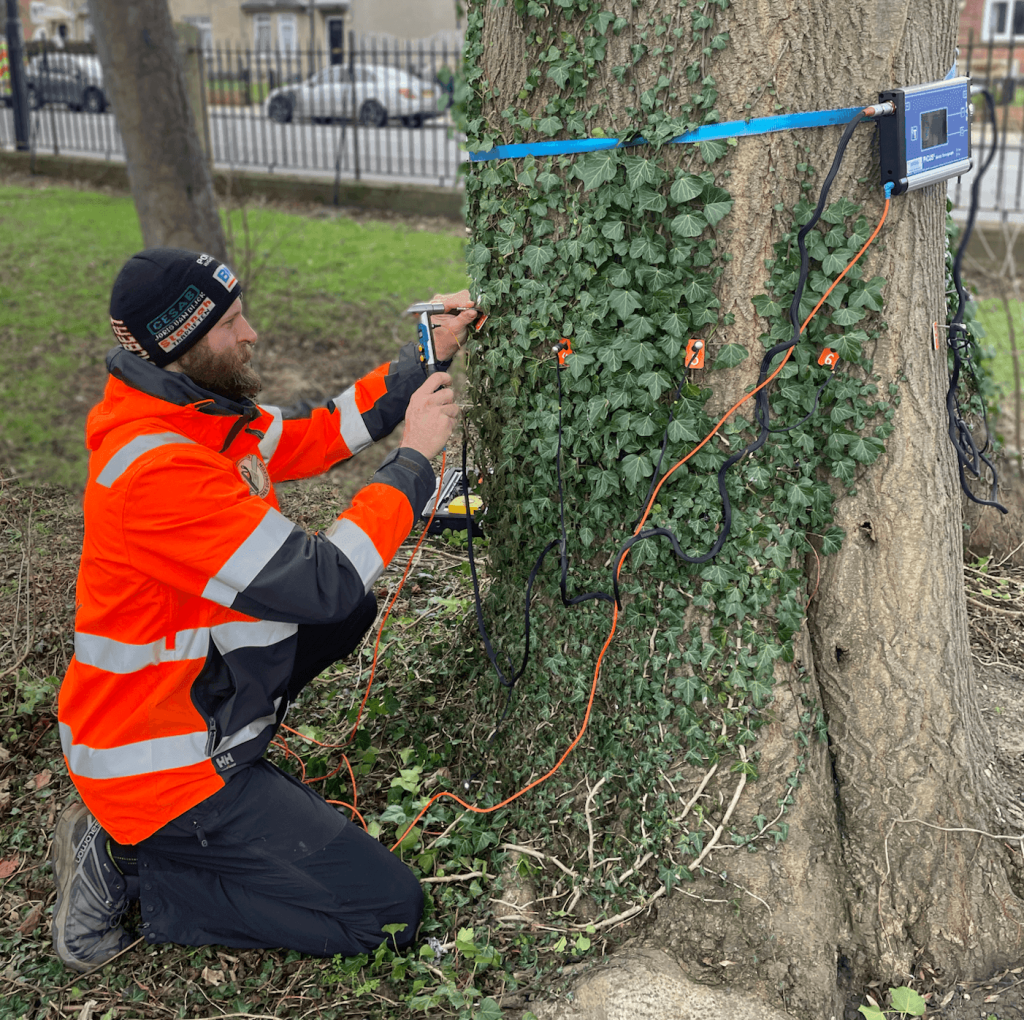
Some situations call for specialist diagnostic work beyond a ground-level look: internal tree inspection, aerial inspection, or soil and root investigation. This sits outside the standard fee. We’ll always quote for it separately and agree it with you before anything proceeds. For internal checks, that can mean sonic tomography testing for internal decay, which uses sound waves to map hidden decay inside the trunk.
Our inspections meet ISO 31000 Risk Management Standards and follow the Health & Safety Executive’s Tolerability of Risk (ToR) Framework. They’re helpful for insurance purposes and legal compliance, and popular with schools, developers, and facility managers who need this as part of their duties and responsibilities.
This will all be detailed in a report, along with any recommendations, whether that’s tree pruning in Newcastle or tree removal in Sunderland. We’ll always do our best to preserve your trees, but if required, you can be confident in our tree felling skills. We are your friendly neighbourhood Tree Fellas, after all!
Quite often we find the level of risk is already acceptable, and most of the time risks are as low as reasonably practicable (low enough without spending silly money!)
How We Report Risk
Where recommendations are made, our reports will give you three priorities:
- High Priority (Red)
- Medium Priority (Amber)
- Low Priority (Green)
These priorities are sequential, not calendar deadlines. They tell you what order to tackle the work in, and what to budget for first, rather than giving you a date by which something must be done.

/
Fast. Affordable. Arb Approved!
Free Quotes
Book a free assessment & talk to our knowledgeable experts for free and find out how much it will cost in just a couple of days.
CLIENT PORTAL
All our clients get access to an online portal; quotation, bookings, and invoices are available to view online, by email or text message.
FAST Felling
We’ll get your tree removed safely and usually within a few weeks of a quotation being approved by our customer.
Full Inventory Tree Survey
Full inventory tree surveys are popular among our commercial clients, particularly those with large estates, schools, housing developments, and business sites. This is because they provide valuable insight into the strengths, weaknesses, and history of your trees.
It involves assessing, and recording, all of your on-site trees and compiling a complete record of them. We’ll tag, map, and reference each tree in our tree survey report, which you can use for future maintenance, planning, and as evidence of health & safety compliance.
Each report can include information about:
- Tree species
- Position
- Size; including height, diameter and spread
- Estimated age
- Health & structural condition
- Targets (things they might do harm to!)
- Level of risk posed
You’ll also receive priority ratings for any tree posing an increased risk and recommended maintenance steps for the future.
A full inventory tree survey is an excellent way to show that you’re meeting your legal responsibilities under the Occupiers’ Liability Act or the Health & Safety at Work Act; they are a worthwhile investment.

“Quick and hassle-free service from initial enquiry… they took their time listening to what I wanted… Super impressed and I’ve gone from disliking to loving the tree…”
Lynsey J. Reay – East Boldon
How Often Should My Trees Be Inspected?
There’s no single answer. NTSG guidance is clear that there’s no universally accepted inspection interval (NTSG 6.6.1.6); how often you need a Walk-over Assessment is a judgement based on your site, what’s beneath the tree, and how often people are there.
As a general guide, significant trees overhanging a well-used area, a road, footpath, car park, or a garden or building people use regularly, are usually inspected around every two years. Trees where hardly anyone goes beneath them can safely go much longer between checks, sometimes without any formal inspection at all. If your trees sit beside a public road or path, it’s worth understanding the risks of trees overhanging roads and footpaths and what the law expects of you.
That two-year figure isn’t a legal rule. It comes from Witley Parish Council v Cavanagh [2018] EWCA Civ 2232, where a parish council was found negligent for not arranging a formal two-yearly inspection of a large, mature tree that could have fallen onto a busy road. The court’s reasoning was about what was reasonable for that tree, in that location, given how much the space beneath it was used, not a fixed interval every tree owner must follow.
The proportionality point is the one that matters: the more a space is used, the more often it needs checking. We can help you work out what’s reasonable for your trees and your site.
Professional Tree Inspections
If you’re worried about safety and compliance, our trained and insured tree surveyors can carry out professional inspections and provide expert advice on tree safety in Newcastle, tree safety in Gateshead, tree safety in Sunderland and tree surveys in Northumberland, before recommending any follow-up tree services across the North East.
Our inspections meet ISO 31000 Risk Management Standards, follow the the approach of the Health & Safety Executives’ Tolerability of Risk (ToR) Framework, and are a popular service, particularly for schools, developers, and facility managers who require regular inspections as part of their duties and responsibilities. Our inspections are broad yet comprehensive, and can include:
- Scheduled, seasonal inspections
- Annual tree audits
- Emergency post-storm assessments
- Routine tree safety inspections
- Tree reports for insurance and planning purposes
- Support with Tree Preservation Orders (TPOs)
It’s important to remember that if you have a tree that’s presenting some obvious tree risk features (signs of decay or structural weaknesses), you may be held liable for any damage it causes.
With this in mind, it’s in your best interest to follow the guidance of the government, the National Tree Safety Group (NTSG), the Forestry Commission, and the Arboricultural Association, which states that professional tree safety inspections are essential for all landowners.

Don’t delay! Book your walk-over assessment, detailed inspection, or full inventory tree survey today
Need some expert tree help, a Walk-over Assessment, or a tree safety report? Contact our domestic and commercial tree surgeons in South Tyneside. We have a full range of tree safety services available across the North East.
Book online or call 0191 432 6167.
Frequently Asked Questions
How often do my trees need inspecting?
It depends on your site, not a fixed rule. Significant trees overhanging a well-used road, footpath, car park, or garden are usually checked around every two years; trees few people go near can go much longer. See “How Often Should My Trees Be Inspected?” above for the full picture.
Will every tree be listed in my report?
No. We use negative recording, a standard NTSG procedure, and only record the trees that need further care in detail. NTSG guidance says recording every tree inspected would be disproportionate.
What’s the difference between a Walk-over Assessment and a Detailed Inspection?
A Walk-over Assessment is a ground-based check of every tree on your property, on foot. A Detailed Inspection is a closer look at one tree that’s already been flagged as a concern, sometimes using specialist techniques like aerial inspection or root investigation.
What does a red, amber or green priority mean?
Red means immediate action is needed, amber means action is required, and green means the risk is acceptable or just needs monitoring. The colours tell you the order to tackle any work in, not a calendar deadline.
Who is responsible for spotting problems between inspections?
You are. As a tree owner, you’re expected to keep an eye on your own trees between formal inspections; informal checks like this don’t need a professional.
Do I have to do the work you recommend?
No. Our report tells you what we found and what we’d recommend, but the decision, and the timing, is yours. We’ll help you prioritise if there’s a budget to work within.